
Veli-Matti Karkkainen’s An Introduction to Ecclesiology, reviewed by Amos Yong

Mentioned in the Winter 2004 issue of Pneuma Review.
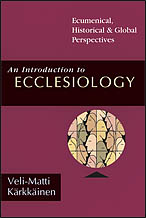 An Introduction to Ecclesiology: Ecumenical, Historical & Global Perspectives. Veli-Matti Kärkkäinen. InterVarsity Press (Downers Grove, Ill., 2002), 238 pages, ISBN 9780830826889.
Veli-Matti Kärkkäinen is a Finnish Pentecostal who teaches systematic theology both in Europe and at Fuller Theological Seminary. He brings to his writing his vast ecumenical and extensive missionary experiences of worldwide Christianity. And arguably, Kärkkäinen is the most prolific Pentecostal theologian in the world today. Building on his dissertation research on the Pentecostal-Roman Catholic dialogues-two volumes: Spiritus Ubi Vult Spirat: Pneumatology in the Roman Catholic-Pentecostal Dialogue (1972-1989) (Luther-Agricola Society, 1998), and Ad ultimum terrae: Evangelization, Proselytism and Common Witness in the Roman Catholic-Pentecostal Dialogue (1990-1997) (Peter Lang, 1999)-Kärkkäinen has since produced a number of introductory texts on key theological topics in an amazingly short period of time. In the last year, two books have appeared: Pneumatology: The Holy Spirit in Ecumenical, International and Contextual Perspective and Christology: A Global Introduction (both from Baker Academic). Within the next year, a volume on the doctrine of God in global perspective will be available (also Baker Academic), as well as two other books on religious pluralism (InterVarsity Press) and the doctrine of the Trinity in relationship to theology of religions (Ashgate).
This background provides a window into the format and objectives of the volume under review. The material presented in this and much of Kärkkäinen’s other books have been shaped by his teaching, and the survey character of these texts make them eminently suitable for classroom use. And, of course, what is most valuable about Kärkkäinen’s introductory surveys is their global awareness, a feature practically absent from most evangelical treatments of these same topics. I gather that this global sensitivity has been nurtured in part because of Kärkkäinen’s background, but also in (perhaps larger) part because the Pentecostalism which nurtures his faith, spirituality and piety is now truly a worldwide movement. Thinking theologically as a Pentecostal today requires just this kind of global vision in order that justice can even begin to be done to the topics under consideration.
This global perspective comes out clearly in An Introduction to Ecclesiology. Sure, one can quibble with Kärkkäinen’s categorizations or selections, but to keep a survey volume like this one manageable, some things inevitably have to be left out. What remains, however, is divided into three parts. Ecclesiological Traditions includes discussions of the doctrine of the Church in Eastern Orthodoxy, Roman Catholicism, Lutheranism, the Reformed churches, the Free churches, the Pentecostal/charismatic orbit, and the ecumenical movement. Leading Contemporary Ecclesiologists include John Zizioulas communion ecclesiology (Orthodox), Hans King’s charismatic ecclesiology (Roman Catholic), Wolfhart Pannenberg’s universal ecclesiology (Lutheran), Jrgen Moltmann’s messianic ecclesiology (Reformed), Miroslav Volf’s participatory ecclesiology (Free Church and Pentecostal), James McClendon, Jr.’s baptist ecclesiology (Anabaptist), and Lesslie Newbigin’s missionary ecclesiology. The last part, Contextual Ecclesiologies, overviews the Non-Church movement of Kanzo Uchimura in Japan, the Base Ecclesial Communities in Latin America, the feminist church (as represented by Letty Russell and Elisabeth Sch’ssler Fiorenza), the African Independent (indigenous) Churches, the Shepherding Movement, the new world church (in dialogue with Catholic moral and political theologian, Oliver O’Donavan, which connects with the phenomenon described by Philip Jenkins in his recently acclaimed The Next Christendom), and the post-Christian Church as another city (in dialogue primarily with Barry Harvey, but in the tradition of prominent theologians like Stanley Hauerwas and John Howard Yoder).
From a Pentecostal theological perspective, however, I want to urge readers of the Pneuma Review to pay close attention to Kärkkäinen’s text. Let me suggest that this volume is not just an introductory survey of various ecclesiologies, including a chapter or two devoted to Pentecostal and/or charismatic ecclesiologies. Rather, read between the lines (or chapters, as the case may be), I discern a distinctively Pentecostal theme: that of the pneumatological motif which runs through the volume. Now, this may be the result of Kärkkäinen’s bias (used not pejoratively, of course). Or it may be that Kärkkäinen has accurately portrayed the contemporary ecclesiological landscape, and that God is truly doing a new thing of the Spirit such that this pneumatological thread has emerged in the text. Or both. Let me explain.
In brief, Pneuma Review readers will be surprised (shocked?) at the recurrence of pneumatic and charismatic motifs across the ecclesiological spectrum. Eastern Orthodoxy, we will learn, is not only ‘spirit-sensitive, but also understands the Church to be constituted by the Spirit. Post-Vatican II Catholic ecclesiology has emphasized the importance of the charisms in the life of the Church (thus opening the door to the Charismatic Renewal in the Church, for sure). Lutheran ecclesiology understands the Spirit to make alive both the Word and the sacraments. Obviously, Pentecostal/charismatic ecclesiologies emphasize the Church as a charismatic fellowship.
Turning to contemporary ecclesiologists, we see similar connections. Zizioulas emphasizes christology and pneumatology as the dual foundations of the Church. King writes about the Church as the creation of the Spirit. Pannenberg’s is a thoroughly pneumatological ecclesiology-an understanding of the Church permeated by the person and work of the Spirit. Moltmann wrote a very influential book titled The Church in the Power of the Spirit (ET: SCM Press, 1977). Volf focuses on the charismatic and trinitarian structure of the Church. McClendon’s baptist vision is very similar to those of Pentecostals, emphasizing the this is that correlation between the present experience of the Spirit and the experiences of the earliest Christians as recorded in the book of Acts (for more, see Yong, The Baptist Vision of James William McClendon, Jr.: A Wesleyan-Pentecostal Response, Wesleyan Theological Journal 37:2 [2002]: 32-57). And, of course, how can one have a missionary ecclesiology such as Newbigin’s without a robust pneumatology? Thus Newbigin’s portrayal of the Church as a community of the Holy Spirit. Pneumatic and charismatic themes are evident also in the contextual ecclesiologies, not only in the African ‘spirit-churches, but also in the Shepherding Movement’s renewal ecclesiology.
My immediate response is, Praise the Lord for what is being done in the Church worldwide. My secondary, critical, response is that the gift of discernment is needed all the more both within and without Pentecostal and charismatic churches. As those of us in these churches realize, not everything that goes on even in ‘spirit-filled congregations and denominations is of the Spirit of God.
This said, a question, a recommendation, and a commendation. The question: does Kärkkäinen not recognize that even European and Western ecclesiologies (and theologies, in his other books) are contextual? If so, then why perpetuate the (implied) notion via his sectional categorizations that Euro-American ecclesiologies (and theologies) are normative and Eastern and Southern ecclesiologies (and theologies) are contextual? The recommendation: Kärkkäinen is undoubtedly one of the most capable Pentecostal theologians in the world today, and perhaps best poised to provide a Pentecostal systematic theology that can begin to measure up to the complexity of the experiences of global Pentecostalism. Will he be open to the Spirit’s leading him in this direction? A foretaste of what may come can be found in his Toward a Pneumatological Theology: Pentecostal and Ecumenical Perspectives on Ecclesiology, Soteriology, and Theology of Mission (University Press of America, 2002).
The commendation: Pentecostal and charismatic pastors, leaders, and laypersons called by God to theological engagement need to read not only An Introduction to Ecclesiology, but as much of Veli-Matti Kärkkäinen as possible. His writings are more accessible than that of most theologians, and, I believe, he has been raised up as a Pentecostal theologian for such a time as this.
Reviewed by Amos Yong
Preview An Introduction to Ecclesiology: http://books.google.com/books/about/An_Introduction_to_Ecclesiology.html?id=d6YjGL_7H-QC