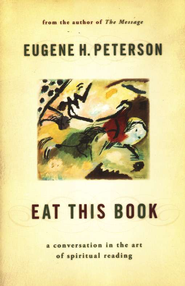
Eugene Peterson: Eat This Book

Eugene H. Peterson, “Eat This Book: The Holy Community at Table with Holy Scripture,” Theology Today (April 1999), pages 5-17.
Does the Bible really have anything to say to us today? If so, how do we find out what it says? Eugene Peterson—best known for his earthy translation of the Scriptures, The Message—offers a fresh challenge to take the Bible as the singular rule for living the Christian life. He challenges Christians to feed on the Word of God wherein our spiritual lives are formed as the Holy Spirit makes the Word real to us.

This former pastor and a retired professor of Regent College (Vancouver) makes his point eloquently, so much so that nearly every paragraph has a statement so quotable one could fill an office with plaques. “Christians feed on Scripture. Holy Scripture nurtures the Holy Community as food nurtures the human body” (p. 6). “God does not put us in charge of forming our personal spiritualities. We grow in accordance with the revealed Word implanted in us by the Spirit” (p. 5). “It is the very nature of language to form rather than inform. When language is personal, which it is at its best, it reveals; and revelation is always formative—we don’t know more, we become more.” (p. 7). “Exegesis is foundational to Christian spirituality.” (p. 9). “Exegesis is loving God enough to stop and listen carefully.” (p. 10). “Scripture is the revelation of a world that is vast, far larger than the sin-stunted, self-constricted world that we construct for ourselves out of a garage-sale assemblage of texts” (p. 12).
For us to feed on Scripture, Peterson says, we must understand that Scripture is God’s revelation to us. Scripture is our text and our form. This revelation is not just informational but formational. The Word must not be merely studied technically but it must be assimilated into our very beings. Likewise, the “meta-narrative” of Scripture is the story about Jesus and the form for us to follow Him.
Peterson’s challenge to return to reading and doing the Word is one to be heeded. If God’s revelation of Himself to us is not our only basis of trust and life, then we will have a flawed and ultimately destructive manner of life. In an absolute sense, only God’s revelation of Himself is true. Therefore, if we remake the Scriptures to fit our preconceived ideas, is it any wonder that we will only end up deceiving ourselves and others?
Wrong ideas about what life is all about come from misunderstanding what God has revealed to us. He is the author of life, and only He can tell us how to really live. I find it encouraging that there are many who are calling the church back to reading and doing the Scriptures. Recently, many articles have appeared in periodicals challenging the church to rethink how they approach God’s Word. Gary M. Burge says that the Bible is “The Greatest Story Never Read,” in his challenge to recover Biblical literacy in the Church (Christianity Today Aug. 9, 1999). Pastor Jack Hayford specifically addressed “Biblical Illiteracy in the Pulpit” in his interview with Ministries Today’s new editor Larry Keefauver. He said, “We must first study the original text in the context of Scripture and its literacy and historical background. Then we go to the commentaries for further illumination. But the original excitement and inspiration we had in studying the text must not be lost or dampened by study. We are not seeking to justify our opinions or insights, but to understand the text and communicate with enthusiasm its truth and application for today” (Ministries Today Jan/Feb. 1999, p. 28).
It is no secret that individuals and ministers from the Pentecostal/charismatic tradition are known for Biblical illiteracy. May we all heed this challenge, regardless of the stereotypes and our backgrounds. It is the Spirit who is bringing this admonition to His Church. We all need to fall in love with the Word and submit ourselves to it. We need to eat this Book.
Reviewed by Raul Mock