Crystal Downing: How Postmodernism Serves (My) Faith

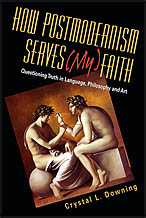
 Crystal L. Downing, How Postmodernism Serves (My) Faith: Questioning Truth in Language, Philosophy and Art (Downers Grove, Illinois: InterVarsity Press, 2006), 240 pages.
Crystal Downing has navigated through the mire of misinformation and mangled terminology to present to her reader a clear understanding of what postmodernity is and is not. More importantly, she has prevailed in providing the Christian Church with an effective tool for the communication of the gospel of Jesus Christ in the postmodern cultural milieu. Regardless of your philosophical aptitude, Downing’s thesis will provide ample food for thought.
What is postmodernity? Postmodernity is not a worldview or an ideology, hypothesized Downing, it is an exposé. It does not point to potential weaknesses in Christianity, Downing opined, but to flaws in modernity. Postmodernity is a reply to, or argument against modernity. Downing’s thesis argued that postmodern theory reopens a door of opportunity for the voice of Christian faith to reenter the academic conversation. In this regard, postmodernity can serve all communities of faith. It is a contradistinction to modernity; postmodernity champions the voices of the marginalized, whereas modernity elevated science and rationality as the only voice of authority. Downing pressed the definition of postmodernity as being against the modern argument—that truth is objectively perceived by reason alone. She posited that postmodernity continues to confront the premise of modernity, which expected science and art to replace Christ as the savior of humanity.
Downing wrote in an easy style, that can be followed with little effort by the non-philosophical reader. She took the time to build her theory around some homey illustrations and on some delightful puns. These will assist the uninitiated to conceptualize some of the abstractions of theory she presented. Along the way she has drawn the attention of the reader to the root meaning of key words and, as an English major, she delights in pointing out not only the origins of these words, but she also calls for the exactitude of their definitions.
The pattern that Downing gives to the reader is linear in format. First, she has laid out the premise for her book. Second, she has labored to build a foundation for her work—gleefully poking fun at herself for using a technique of modernity to illustrate a postmodern text. Next, she has taken the reader systematically through the ideas of significant philosophers, noting their contribution to the development of modern and postmodern worldviews. Along the way, Downing includes enough footnotes to provide the curious with some direction for further inquiry and she gives the reader an ample number of brief quotations—from her roll call of popular authors and prominent philosophers to punctuate her points of progress.
For the conservative interpreter of the Bible, Downing has articulated how postmodernity makes the faith-based interpretation legitimate once again, perhaps providing hope for the niggling angst towards Bultmann’s demythologizing. For the liberal interpreter of the Bible, Downing has articulated how postmodernity accommodates alleged non-literal problematical texts (i.e. six-day creation), possibly without compromising the essentials of orthodox Christianity. For the one who is befuddled over the meaning of the term “postmodern,” Downing leads to comprehension, using the clearest language that this reviewer has yet to read. For the one who is somewhat familiar with philosophy, Downing’s book provides a quick refresher to the philosophers and their ideas.
Reviewed by John R. Miller
Publisher’s page: https://www.ivpress.com/cgi-ivpress/book.pl/code=2758