

Ida Glaser: The Bible and Other Faiths

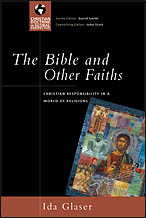 Ida Glaser, The Bible and Other Faiths: Christian Responsibility in a World of Religions, Christian Doctrine in Global Perspective, Series Editor, David Smith, Consulting Editor, John Stott (Downers Grove, IL: InterVarsity Press, 2005), 255 pages.
The Bible and Other Faiths ably brings together a unique set of concerns which aren’t often considered together under a single cover. Author Ida Glaser is Academic Director of the Centre for Muslim-Christian Studies in Oxford and an Associate Tutor at Wycliffe Hall, Oxford. Previously she was a Senior Teaching and Research Fellow at the Edinburgh Centre for Muslim-Christian Studies and on staff at Crosslinks, an Anglican mission society. Her expertise focuses on areas of Islam, interfaces between Qu’ran and the Bible, comparative religions, and Christian mission. The Christian Doctrine in Global Perspective series is an effort by Evangelicals to help theological contributions overcome a Western monopoly in the Christian academy.
Immediately apparent is Glaser’s extensive experience in dealing with Christian relations with other religions. Her parental background is marked by both Jewish and Christian traditions. Add her experience working with Muslims for a fascinating and informative mix. As noted above, her professional experience is even more abundant. Yet her clear and accessible writing style is helpful to readers who are not nearly as expert as she. Glaser carries on conversations about more technical aspects of her topics through fairly copious endnotes. In this way, readers who are interested in delving deeper into such aspects may do so but others may proceed without distraction with focus on the more free flowing body of the text.
To begin, Glaser suggests that competition between Christianity and other religions is in part fostered by a bias toward certain questions that Christians often tend to ask. Is Christ the only way? Can people of other religions get to heaven? Are they worshiping God or the devil? She suggests we should be asking a different set of questions. How can we understand the religions and the way they affect human beings? What has God done for people of different religions? What is God now doing among them? How should we respond to the gods of other religions?
The former questions supposedly lead to conflict, and thus to undermine coexistence. The latter supposedly encourage Christians to understand and accept responsibility for their own ideas about religious others, and thus to foster cooperation and coexistence. My initial impression of this juxtaposition is to affirm the latter set of questions without avoiding the former set. In other words, focusing on the eternal destiny of those of other religions without giving attention to our earthly relationships with them as Christians is incomplete at best and, at worst, potentially a prime contributor to chronic problems. Yet as Christians we cannot ignore anyone’s eternal need of Christ. Thus, we may have more both/and conversations than either/or ones. Yet Glaser’s searching study of the Scriptures does indeed provide abundant help in working through both sets of questions. She doesn’t offer easy answers but she does help us open up to hear what God’s Word says to us.
Glaser shares the heart-rending story of her time in January 2002 in Jos, Nigeria. She learned that during the previous September Christian and Muslim youths set up roadblocks and stopped cars. Only if people were from the “right” religion were they allowed through. To verify people’s religion the youths devised a plan. Muslims asked them to recite the shahada (Muslim creed). Those who failed were killed. Christians asked them to recite John 3:16. Those who failed were killed.
All of this is in sharp contrast with the so-called deities, or idols, of the Canaanites. Why? It is because Israel’s God is the God who really exists. He is (Exodus 3:14). God cannot be defined or controlled by human religion. Although Israel is his special people, the whole earth with all its peoples belongs to God. Accordingly, God’s purpose for Israel is for them to be a kingdom of priests and a holy nation. The distinctiveness of their God made their identity as God’s people a source of missional destiny in behalf of other nations. Rather than cutting Israel off from their neighbors of other faiths, their faith in the One God conferred responsibility toward them.
Glaser garners significant insights for understanding other faiths from the story of the woman of Samaria at the well and the debate at Corinth over food offered to idols. These offer rich resources for balancing real faithfulness to Christ with respectful openness to others. The treasures she mines from Scripture are valuable truths that, if acknowledged and obeyed, could transform our world. And that’s Glaser’s basic point throughout this helpful and informative book. In a day of essentially mass confusion over how to understand and address the perplexities of interreligious coexistence, she brings us back to the Bible for critically needed aid. This reason alone is enough to highly recommend The Bible and Other Faiths to pastors and parishioners as well as scholars and students who desire to behave biblically in the area of interfaith relations.
Admittedly, I sometimes felt frustrated reading The Bible and Other Faiths by Ida Glaser. The research is well done. The writing is first rate. And vitally important implications for interfaith relations are clearly evident. However, its tone is too tentative. Often after an exceptional overview and analysis of a relevant biblical passage or topic when readers likely would be ready for sound applications or at least strong implications she would simply draw back leaving us hanging. I can appreciate a non-dogmatic tolerant approach to interpreting the biblical plot; but, at some point we need to bring it to a close, to wrap it all up, to unflinchingly affirm where we ourselves at least feel it points us. What’s the point of it all? In the margins of my copy of The Bible and Other Faiths I sometimes wrote, “If so, then what?” We need direction.
Sometimes we need to go ahead and commit! At least, be plain about our own best guess and thus our best advice to others. They can take it or leave it or some mixture of both as they so choose. And Glaser does clearly commit on one point: the thrust of Micah 6:8 for Christians’ understanding of and interactions with other faiths. The Lord requires us “To act justly, to love mercy and to walk humbly with your God.” This sublime text sums up our responsibilities toward God and all human beings—including people of other faiths. She’s quite clear on that point. And it’s a very good one.
Reviewed by Tony Richie