Jonathan Pennington: Reading the Gospels Wisely

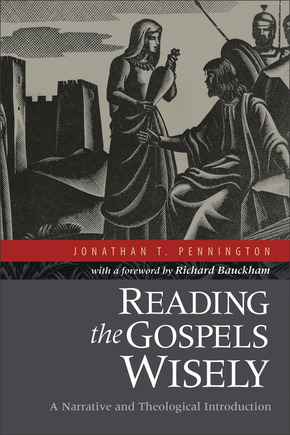
 Jonathan T. Pennington, Reading the Gospels Wisely: A Narrative and Theological Introduction (Grand Rapids: Baker, 2012), 268 pages.
Employing a narrative-theological approach to understand the Gospels, Pennington uses lively prose but maintains a rigorous scholarship governed by a great respect for Scripture. Pennington writes in the same historical and theological hues of Martin Hengel and Richard Bauckham, following the latter’s argument for apostolic eye-witness testimony closely. Eminently practical, Pennington writes so that “readers will be invited into the joy of studying the Gospels more deeply and more often” (258) and to lead readers to respond to the Gospel’s message of faith in Jesus Christ.
Pennington reconnects the church and the academy, erasing the disjuncture between Scripture and the people. Preaching and teaching the Gospels is not some addendum tacked onto Pennington’s hermeneutical project: “I take guidance and courage here from the model of Augustine, whose one-thousand-year best-selling textbook on hermeneutics has for its final climactic section, a lengthy discussion of how to preach” (219). For Pennington, the Gospels are Holy Scripture: a meal to be eaten and not an FDA report on the organic components of a foodstuff. Contra form-criticism, we should not be concerned with the Sitz im Leben [German, “sit in life,” life-setting] of a text but its Sitz im unserem Leben, that is, “our life-setting” (156).
The book breaks up into three sections: “Clearing the Ground, Digging Deep, and Laying a Good Foundation” (chaps. 1–8), “Building the House through Wise Reading” (chaps. 9–10), and “Living in the Gospels House” (chaps. 11–1). Pennington first traces the development of the word “gospel,” which initially referred to the kerygma [Greek proclamation], but then the notion of written document was added to it. Pennington roots the gospel message in the Old Testament, especially Isaiah 40–66, which points Gospels study in the right direction. Chaps. 1–2 do a good job of defining the Gospels and forging the relationship between genre and hermeneutics. Gospels are broadly subsumed under the Greek category of bioi [Greek “lives,” biographies] (22). Pennington follows Richard Burridge, who has established the Gospels as Graeco-Roman bioi. Yet bios is a flexible genre and will inevitably share characteristics with “moral philosophy, encomia … and historical works” (23).

Going beyond Burridge, Pennington opts for “bios plus” (25). He follows Loveday Alexander, who points out that the Old Testament is “much more deeply prone to ‘bio-structuring’ than is classical Greek” (26). Alexander says that it is the biblical tradition that provides the Gospel narratives their “rich ideological intertextuality with the biblical themes of covenant, kingdom, prophecy, and promise—all features hard to parallel in Greek biography” (26). Pennington then borrows from Adela Yarbro Collins, who also critiques Burridge but adds the categories of apocalyptic and eschatology to Gospel bioi (26). Pennington agrees with Collins’ labeling Mark an “eschatological historical monograph” (27). But he emphatically notes that the Gospels are even more. They do not—as Greek bioi—merely tell of a dead figure with emulation in mind but proclaim the resurrected Jesus who is present for the readers. “This is good news, not just a biography!” (31).
The genre of bios also assists apologetically, as ancient bioi “often mix chronological and topical elements in a way that we may not expect.” Additionally, this genre only needs to capture the ipsissima vox [Latin “the very voice”] and not necessarily the ipsissima verba [Latin “the very words”] (31–32). Pennington argues that we should not view the Gospels as clear panes of glass and try to look through them to find the historical Jesus. The vertical reading of each Gospel is an inspired and inextricable meshing of the historical Jesus and theological interpretation. For Pennington, this is good and to be expected, because no history is penned without selection and interpretation. The Gospels are “sermons” with transformation in mind (34). To me, this invites the distinction that the Gospels are not propagandistic but evangelistic.
Pennington argues against the Gospels being read harmonistically (chap. 4), as in Tatian’s Diatessaron, which Augustine pronounced against. Harmonizations are viable at times, as in the nativity stories in Matthew and Luke. Moreover, Jesus’ itinerant ministry suggests that he said similar things differently at times, so harmonization or even recourse to ipsissima vox may not always be necessary. Pennington paves the way for continuity between John and the Synoptics (chap. 4), but more needed to be done here, and Pennington’s coverage was too brief (64–66). Chap. 5 profits from Murray Rae’s insights on history and its relationship to theology, vis-à-vis the Enlightenment. Pennington notes Martin Kähler’s observation that the historical-critical scholar of the Gospels becomes the “fifth evangelist” (76), articulating my own sentiments. Pennington argues that personal interpretation is not merely an unavoidable evil; it is a necessary good so that biblical historicists who hold that “we can somehow access the truth without the ‘interference’ of personal interpretation,” are wrong. (96–97). He prefers Richard Bauckham’s idea of testimony over against historical positivism, while also anchoring testimony in Paul Ricoeur’s epistemology: Testimony is “irreducible” and is the “bedrock of our understanding of history and indeed all reality” (101). Yet this does not imply that all testimony is equal or that the referential component of testimony is unimportant. Pennington shows balance by saying that “We must not lose history in doing theology, and we must not lose theology in doing history” (103).
“Reading Holy Scripture Well” (chap. 6) provides a helpful analysis of hermeneutical approaches, which Pennington divides into three categories: reading “behind” the text, “in” the text, and “in front of” the text (112). This translates to (1) the standard historical-critical approaches, (2) the newer criticisms like literary and narrative criticism and intratextuality, and (3) the history of interpretation and Wirkungsgeschichte or “effect history” (see. chart on 112). Pennington informs in chap. 7, that we must “categorically reject … some mysterious, intermediary thing called ‘the meaning’ that stands between the text and its application” (135). This is because texts are not merely locutions; they are also illocutions (133), which means the biblical text is asking us to do and apply something and not merely to know something. The application of doing is the meaning. A good summary and further elaboration of what has preceded appears in chap. 8. Pennington nicely leverages the supposed disadvantage caused because the Gospels were written after the events. For him, “The best history writing consciously marries event and meaning. This is what it means to provide testimonial history” (151). This interpretive advantage is gained because the evangelists were “writing their accounts precisely with [a] post-Pentecost perspective and expert analysis and commentary” (153). Thus, distance is positively nuanced as perspective and enhancement.
Interaction with the scholarly literature abates in chaps 9–10, as Pennington outlines a reading strategy for the Gospels. Rather than a haphazard reading method, Pennington proposes a narrative model using Luke 7:11–17 (the raising of the widow of Nain’s son). He is careful not to undermine his own thesis by providing a reading model: If we subject the Gospels to analysis—even his analysis—the experience is robbed from us. Nor are we merely to be fact or idea hunters, discarding the story’s particulars as husk. Here Pennington follows Leyland Ryken: “To reduce a story to its ‘ideational content is to rob [it of its] power, distort its true nature, and make it finally unnecessary’” (180). Chap. 11 instructs on teaching and applying the Gospels, and the hermeneutic in chap. 12 makes a lot of sense. Pennington sees the Gospels as a canon within the canon (230) playing “a skeleton-key role in unlocking the understanding of the whole Bible” (247). The Gospels are the keystone, with the Old Testament on one side with the crucial word being fulfillment. The New Testament is on the other side, and the Gospels provide the starting point for understanding it (253).
Pennington argues for a paradigm shift. “Rather than emphasizing a separation and distance between us and the texts of Scripture—a distance that can be transcended only by an elaborate set of exegetical tools—we must come to see that the biggest difference is our lack of knowing and loving God; the real divide is between us and God in the text” (137). This goes beyond even the newer literary and narrative criticisms (or even reader-response criticism). It self-consciously blends a literary reading that is not ignorant of historical-criticism but adds a love for God and posits the Bible as Holy Scripture. Pennington articulates many things that I have been wrestling with in the areas of history and theology. Rarely do I read a book that ‘reads me’ so well. I highly recommend this text, especially for those who have been fed a cold diet of higher-critical books and methods. We must develop a “posture” or “habitus” because, “Our goal in reading Scripture is not merely to understand what God is saying … but to stand under his Word” (137). The text would be improved with a bibliography.
Reviewed by David L. Ricci
Book companion page: readingwisely.com
Preview Reading the Gospels Wisely [available as of Feb 24, 2015]
Publisher’s page: http://bakerpublishinggroup.com/books/reading-the-gospels-wisely/327160