
Moving Mountains: Lessons in Bold Faith from Great Evangelical Leaders

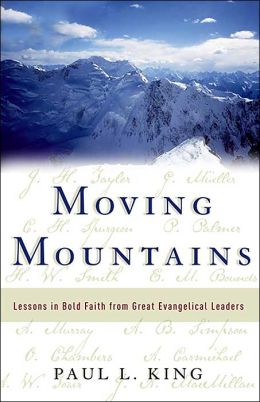 Paul L. King, Moving Mountains: Lessons in Bold Faith from Great Evangelical Leaders (Grand Rapids: Chosen, 2004), 255 pages, ISBN 9780800793753.
Paul King’s Moving Mountains is much more than ordinary hagiography. It is more like a practical textbook on living the life of faith. Make that living the life of faith with boldness. Add balance too, and you have the heart and soul of this book. Anyone who struggles with or has ever struggled with how to understand and apply the vibrant faith of the Bible in daily life without allowing it to degenerate into the fanatical faith so common in some Pentecostal and Charismatic circles will probably benefit from reading Moving Mountains. Church leaders, clergy, and laity alike will find it enjoyable, informative, and inspiring.
Paul L. King is ordained in the Christian and Missionary Alliance and a professor at Oral Roberts University. He has two doctorates, a Doctor of Ministry (ORU) and a Doctor of Theology (University of South Africa). He oversees the ORU Bible Institute Program and teaches seminars on healing and on ministry and leadership development internationally. His expertise in nineteenth and early-twentieth-century classic leaders of faith, healing, and holiness, shows significantly in this text. He is widely published in popular and academic journals, and has two previous books, Binding and Loosing: Exercising Authority over the Dark Powers and A Believer with Authority: The Life and Message of John A. MacMillan. He considers himself something of a bridge person between Charismatics and the broader Evangelical community. That dual perspective is certainly evident in this work. Moving Mountains is one of those books which is not explicitly academic in tone, having a strong devotional slant, but in which discerning readers will observe that careful research is nonetheless behind its writing. It is very readable but not at all shallow. King achieves this blend of depth and devotion by focusing on the biographies of some well-known Evangelical leaders from the nineteenth and twentieth-centuries while ferreting out of their respective lives clear and concise lessons for the contemporary walk of faith.
Appropriately enough, and in true Pentecostal tradition, King begins by sharing something of his own testimony in the Introduction. While a youth pastor at a local church in the 1970s, King was enamored by and embraced the teaching of the “Word of Faith” movement with its stress on faith’s positive confession (popularly known as “name and claim it”). Through continuing education, especially through learning sound biblical hermeneutics, he concluded the movement’s teachings were unbiblical. However, later on, during a time of prayer over physical illness, he began to consider that he might have discarded sound aspects along with the unsound. In faith, he began confessing his healing; though medical treatment had previously failed, he soon experienced divine healing. Thereafter, King began to study in depth the faith movement in an effort to distinguish between valid and invalid features. He found his answers through the lives and teachings of great Evangelical leaders of yesteryear. He suggests that, “these great evangelical leaders taught and practiced a form of faith that is both strong and sound” (p. 13). Moving Mountains admirably intends to commend this “strong and sound” approach to its readers.
King studies faith in the lives and teachings of George Müller, J. Hudson Taylor, Charles H. Spurgeon, Phoebe Palmer, Hannah Whitall Smith, E. M. Bounds, Andrew Murray, A. B. Simpson, Oswald Chambers, Amy Carmichael, John A. MacMillan, and A. W. Tozer. In each case, he designates the respective leader with a short descriptive title and a single sentence summary of the primary “faith principle” exemplified in his or her life and work. George Müller is the “Apostle of Faith” and the faith principle of his life is “You can depend totally on God”. Phoebe Palmer is a “Trailblazing Woman of Faith” exemplifying that “Faith comes by full surrender and trust”. Again, Andrew Murray is “Minister of the New Covenant” exemplifying “You can claim your inheritance promised in the New Covenant” and John MacMillan is “A Believer with Authority” exemplifying “You can exercise spiritual authority as a believer”. King proceeds in similar fashion through each of his selected subjects. He begins each chapter with an exciting example of the faith principle at work in their lives. Then he introduces them personally more fully, briefly reviewing their lives and major accomplishments in ministry, before examining one by one the main lessons one might learn from them about living by faith. He closes each chapter with an exhortation to readers to emulate these leaders, followed by several discussion questions and recommendations for further reading. The book also has helpful endnotes and index.
My personal favorite in King’s list of Evangelical leaders, which I will use as an example of his treatment of the others, is A. W. Tozer (1897-1963). Tozer is God’s “Twentieth Century Prophet and Mystic” who exemplifies the faith principle that “Faith pursues after God Himself”. King tells how Tozer, overcome with passion for God, literally wrote his classic The Pursuit of God while riding a train from Chicago to Texas because he just could not stop himself. He describes how Tozer, converted at age seventeen by a lay preacher at a street meeting, went on to serve as a pastor for 44 years and to be a prolific writer and editor. Though not formally educated (not even high school!), he educated himself in theological and classical Christian works and received two honorary doctorates. Most of all, Tozer was known as a man of deep prayer and worship. His preaching and writing were so prophetic they earned him the designation “the conscience of evangelicalism”. He influenced many great Christian leaders, including Wilbur Smith, Warren Wiersbe, and Leonard Ravenhill. He counseled others such as Billy Graham, Catherine Marshall, and Senator Mark O. Hatfield. Tozer spoke and wrote from the heart and the leading of the Holy Spirit. His faith principles, fleshed out with examples and insights, include: have a passion for seeking after God, you can be confident of God’s will and provision for your life, seek not great things for yourself, in the walk of faith the way up is down, truth has two wings, and faith must be sound—not all faith pleases God. King climaxes with “You, Too, Can Have a Heart That Seeks after God!”
A refreshing aspect of Paul King’s Moving Mountains is that he shows both the struggles and the triumphs of great men and women of faith. This is one way he maintains what I would call his “balanced boldness”. Hannah Whitall Smith experienced divorce and the death of children but in faith still affirmed the “Christian’s secret of a happy life”. Another way King maintains balanced boldness is by showing how some of the greatest faith teachers held paradoxical points in tension. A. B. Simpson personally experienced and publicly preached miraculous healing, yet suggested God sometimes works his purposes in sickness and insisted that one should abandon medical treatment only if God has given special faith. Amy Carmichael experienced dramatic divine leading but humbly taught on “God Turns our Missteps into His Steps”. I am so impressed with this dual emphasis of balance and boldness in this writing that I am tempted to suggest later editions change the subtitle to Lessons in Balanced and Bold Faith from Great Evangelical Leaders.
In the Epilogue, Dr King admits he gives only a small sampling of great Evangelical leaders of faith. He even lists several further suggestions. Although King’s selections commendably include diversity across denominational, gender, and some geographical lines, cultural and racial diversity is lacking. He mentions Chinese preacher and writer Watchman Nee but there is no Evangelical representation from the East. Neither is there African American or Hispanic representation. A study of someone like William J. Seymour would have strengthened the work. Certainly, his dynamic but humble leadership of the Azusa Street Mission and Revival was a living laboratory of faith principles in action.
As stated, Paul King’s Moving Mountains is more than ordinary hagiography. I recommend it for its potential to be not only informative but also transformative—at least for those who read it in faith!
Reviewed by Tony Richie