The 2016 Society for Pentecostal Studies Convention in Review

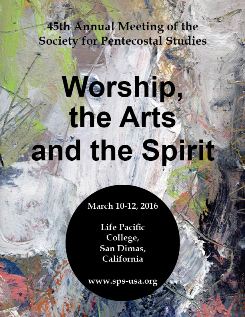
The 45th Annual Meeting of the Society for Pentecostal Studies (2016) was hosted in San Dimas, California at LIFE Pacific College which is associated with the International Church of the Foursquare Gospel. The following sessions are only a small sampling of those which occurred over the three days of the meeting. 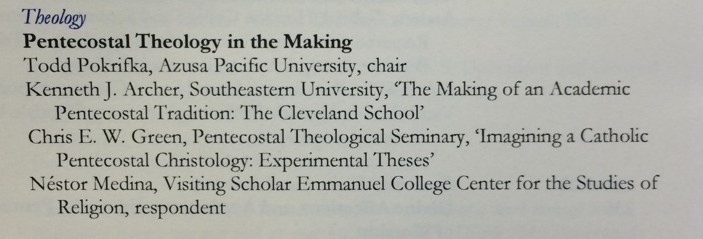

For the Theology Interest Group on Thursday afternoon, Ken Archer presented a paper laying out three decisive moves of the “Cleveland School” as well as four key thinkers beginning in the 1980-1990s (Stephen Land, Cheryl Bridges Johns, John Christopher Thomas, and Rickie D. Moore) whose writings and contributions to Pentecostal studies were the catalyst of this “School”. The three moves were:
- Pentecostal spirituality was distinctly embraced
- A linguistic turn to context extradited understanding
- An adaptation of postmodern theory from Pentecostal perspective was adopted
As part of the distinctly Pentecostal spirituality the foundational significance of five-fold gospel (Jesus saves, sanctifies, baptizes in the Holy Spirit, heals, and is soon coming king) seems always to be present in their work. Further, their Pentecostal spirituality thus belongs to the more Wesleyan stream and therefore also tends to be more Eastern/Catholic in orientation.
The “Cleveland School” (a name given to this particular approach to theology and biblical reflection) explicitly self-claims a Pentecostal identity with even its negative effects. These thinkers and their students are unapologetic about being Pentecostal. While they were early on marginalized it gave cohesion for the development of a distinct group identity. This group also works distinctly for the Church and advancement of the kingdom rather than specifically for academia. According to Archer, M. Cartledge may have been one of the first to write of the “School”, though James K.A. Smith may actually have been the first to use the term.
As part of their theological and biblical work, those associated with the “School” have taken up W. Hollenweger’s emphasis on the early Pentecostals and their literature as being the heart of the movement. Their work is often informed by an early Pentecostal Wirkungsgeschichte (history of effects) approach which pays careful attention to the early literature of Pentecostals and how they heard the various theological and biblical issues being studied.
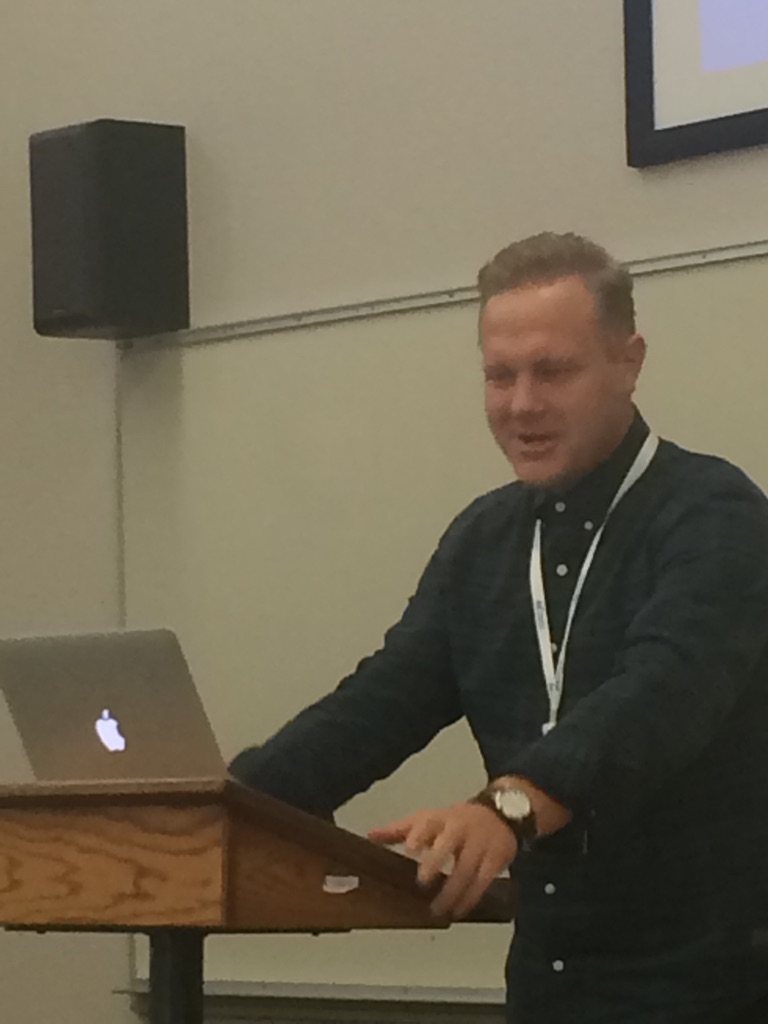
Chris Green (in typical fashion) offered a work in progress as one who is always trying to continue discerning. He delivered (part of his) thirty-nine theses on Christology. Chris used G. Hunsinger’s typology of low, high, and middle Christologies as a more helpful categorization that the normal bifurcated low and high categories. He offered numerous points at which he contended Pentecostals have tended (typically) toward forms of Christology that treat the deity as overly distinct from the humanity of Christ. He offered that there is a pastoral danger of an exemplar Christology that sees Jesus as little more than an example to be followed in his humanity. Further, he contended that Pentecostals should not be overly quick to embrace J. Moltmann’s theology of God suffering (see his “Crucified God”) which may simply be a low kenotic Christology in how one conceives of Jesus’ life, but a high Christology for his death on the cross.

Néstor Medina gave a spirited response to both Ken and Chris. He contended that a Pentecostal school should be clarified as one form of a multiplicity of Pentecostalisms with emphasis upon the plurality within the broad notion of what makes one “Pentecostal”. He further noted that it was in the first years that the various groups were segregated. He also contended against the interpretive triad of the Cleveland School of Spirit, Scripture, and Community (a book being written with that title by Ken Archer) as failing to account for cultural contexts which are particularized variously and not reflecting the broader scope of Pentecostalisms. He also argued that there is a lack of focus on where Pentecostals are going if social political and cultural contexts are what is informing this “School” and if this “School” should be determinative of what it means to be “Pentecostal”. He asked whether the “Cleveland School” might take action to actually make a difference in the world. In response to Chris Green, Néstor questioned the speculative nature of Chris’s theses. He challenged Chris on the relation of the divine and human natures of Jesus. He further suggested that Chris give precedence to the divine over the human, to John’s gospel over the Synoptics.
 Later on Thursday, I attended one of the Biblical Studies Interest Group sessions. This one was on The Writings and Prophecy.
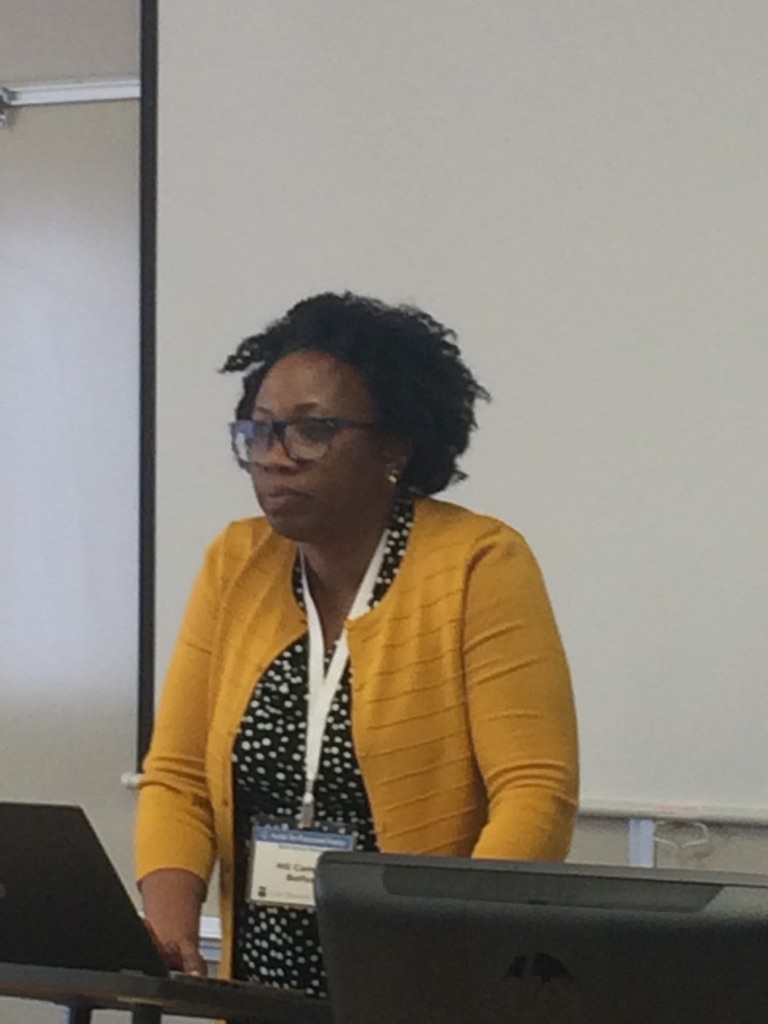
Camilla Belfon presented on the role of memory in the reFormation of the Yehud. Sadly I missed the first half of her presentation, but in the second half she addressed the issues of how one might hear the relation of marrying the “foreigner” in earlier texts and in Ezra and Nehemiah. The move from acceptance to trying to identify who belongs and who does not played a significant role in the identity of reconstituted Yehud.

Following Camilla, Isaac Lund examined the continuity between the minstreling prophets of the pre-exilic period (in 1 Samuel) to the Sons of Asaph in Chronicles. He proposed that the Levitical singers replaced the prophetic band of the earlier period and inquired whether the prophetic office had passed to the Levites?

Matthias Wenk presented the closing paper of that session by asking whether we should differentiate so sharply between OT and NT prophets and prophecy? He contended that the heart of Israel’s prophetic tradition was remembrance of God’s deeds rather than simply declaring what might be in the future. He further pointed to the NT context of 1 Corinthians 1-2 where he demonstrated the New Exodus motif as central to NT prophetic ministry. He posited that Christian kerygma and pneumatic revelation belong together. In essence he contended that prophecy is not simply inspiration, but memory.

On Friday, John Goldingay delivered a moving plenary address on “The Holy Spirit and the Psalms”. He shared of his early despising of the Psalms and only through suffering the loss of his first wife did he come to see the Psalms for the impassioned prayers of the saints and offering the words of the Spirit as life-giving. He will be posting this paper at his website: http://infoguides.fuller.edu/content_mobile.php?pid=190354&sid=1596614
Sadly, I lost my notes from the remainder of the meetings, but can conclude by noting that this meeting was inspirational to my own work on the Spirit and its further reflection (as an example here is my paper presented there on Thursday morning in the Biblical Studies Interest Group: When Prophets Play the Lyre: Saul and the Strings of the Spirit). I was challenged by the many papers (as usual) and blessed by the Spirit in which the meetings were conducted and the fellowship that was woven throughout. I was particularly blessed by the closing banquet where there was a memorial for R. Hollis Gause (which moved me to tears), honoring of Murray Dempster, Byron Klaus, and Doug Peterson (their contributions to Pentecostalism), and joining together around the Lord’s Table ministered by newly elected Second Vice-President – Rev. Dr. Mark Cartledge.
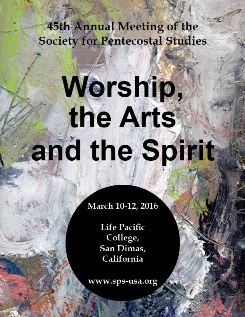 For the full schedule of presenters and their topics see the The 2016 Program.