Tony Richie on Kingdom of Heaven and Justification

Must Re-centralizing Jesus Mean Displacing the Spirit? A Review Essay of Scot McKnight’s “Jesus vs. Paul”
In this review essay, Tony Richie responds to Scot McKnight’s article that introduces a conversation among theologians.
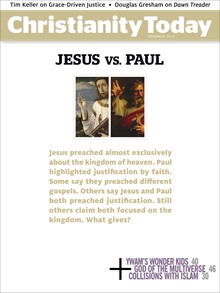 Scot McKnight, “Jesus vs. Paul” Christianity Today (December, 2010), pages 24-29.
The December 2010 cover encapsulates the discussion:
Jesus preached almost exclusively about the kingdom of heaven. Paul highlighted justification by faith. Some say they preached different gospels. Others say Jesus and Paul both preached justification. Still others claim both focused on the kingdom. What gives?
Scot McKnight is an accomplished New Testament scholar and award-winning author whose work often has an innovative tone and, sometimes, a controversial twist. In “Jesus vs. Paul,” McKnight tackles a disturbing disjunction within Evangelicalism.1 An older generation of evangelicals tended to follow the Reformation tradition quite tightly, making Paul’s doctrine of justification the essential doctrinal rubric for individual salvation; but, a new generation of evangelicals has become entirely enamored with Christ’s kingdom teaching applying its social implications. Devotees of each approach tend be exclusive or dismissive of the other. A troubling dichotomy between gospels and epistles develops. McKnight considers this a serious crisis threatening the theological stability of church and academy. He thinks both approaches risk reductionism. However, he resists facile attempts at superficial harmonization. For McKnight, the solution resides rather in the concept of gospel itself, particularly as delineated by Paul in 1 Corinthians 15:1-8. The category of gospel, he argues, is broad enough to include both Jesus and kingdom with Paul and justification in a complementary, or perhaps better, in a comprehensive, manner.

McKnight defines “gospel” summarily as the “saving story of Jesus that completes Israel’s story.” A prime benefit for McKnight is it’s re-centralizing of Jesus. He thinks that an overemphasis, that is to say, for all practical purposes, a sole emphasis, either on kingdom or justification tends to displace the person of Jesus, while the category of gospel places Jesus back at the center of what Scripture says, and of what Christianity is all about—faith in the person of Jesus Christ. McKnight has no problem producing multiple texts indicating that the New Testament calls for faith in Jesus as Lord and Savior rather than in his kingdom teaching or Paul’s views on justification. Accordingly, he argues against beginning either with kingdom or justification. Instead, McKnight says, “The gospel is the core of the Bible, and the gospel is the story of Jesus.” Therefore, he urges us to begin our hermeneutical and theological tasks with gospel.
Nevertheless, isn’t it odd with his argumentation about respecting Jesus and Paul in their own right, that McKnight uses Paul to define gospel, and thereby, Jesus, after all? Does McKnight’s proposal really rescue us from an Evangelical predisposition toward Pauline imposition on Jesus? Therefore, is his definition of gospel full enough?
Now I’m brought to my fundamental consideration. I don’t think Scot McKnight’s exegesis or reasoning is amiss. He does first rate work. Rather, I wonder if the framing of the issue itself may be at fault. I wonder about the proclivity to try to find any one term or text that can carry the weight of all the biblical teaching. Further, I worry about what (really, who!) gets excluded or marginalized in the process. I advise caution. Let me illustrate.
Oddly enough, while McKnight, quite correctly I think, argues that primary focus should be on the personal identity of Jesus Christ, the key text he has chosen doesn’t emphasize Jesus’ personal identity at all but rather his atoning work.1 Corinthians 15:1-8 does not reference Jesus’ divine sonship or lordship; rather, it relates his death, burial, and resurrection. It appears that a strict reading leads to a truncated gospel—if this text fully defines gospel. I’m not claiming McKnight would take it so far, probably for him it is more like a window into a larger reality; but, I imagine some may. And besides, how large is that window anyway? I certainly won’t argue that Christ’s death, burial, and resurrection isn’t gospel! But, is it the gospel, the entire gospel? Is there nothing else that qualifies as gospel? Perhaps Pentecostal and Charismatic Christians might have special cause for concern. After all, where is the Spirit in this “gospel”? Talk about displacement!
That the gospel of God’s grace in Christ has a desirable fullness often associated with the Holy Spirit can be substantiated easily enough from Scripture (e.g., John 1:16; Acts 2:4; 4:8, 31; 9:17; 13:9, 52). It might even be taken from Paul (Romans 15:29). It’s particularly prevalent in Ephesians (1:23; 3:19; 4:13; 5:18). But it isn’t readily evident in 1 Corinthians 15:1-8. In fact, the Holy Spirit isn’t mentioned there at all. Perhaps this explains why the Holy Spirit doesn’t appear in McKnight’s article either (other than a passing reference and an incidental quotation). A leading question demands to be asked: Is Pentecost part of the gospel? Sectarianism aside, I submit that the Holy Spirit is necessary to the good news of Jesus Christ. As the apostle says, “But you were washed, you were sanctified, you were justified in the name of the Lord Jesus Christ and by the Spirit of our God” (1 Corinthians 6:11b). According to Gordon Fee the Spirit is not only essential but central for Paul. Marty Mittelstadt’s work reflects a similar scenario in Luke-Acts. None of this is included in or could be concluded from McKnight’s solution to an unfortunate bifurcation among evangelicals. His article certainly doesn’t provide explicit space in gospel for the Spirit.
Probably Professor McKnight’s oversight is due to the piece’s brevity. However, some make the Spirit’s person and work peripheral to gospel. Theologically that doesn’t work well—not even for non-Pentecostals. The renowned Roman Catholic scholar, Yves Congar, one of the great pneumatologists of recent times, had a succinct dictum that is telling: “no Christology without pneumatology and no pneumatology without Christology.”2 If Christology, as McKnight maintains, is at the center of the gospel, then pneumatology is right there alongside it.
Yet pneumatological amnesia is a particular problem for Pentecostals and Charismatics. Although I was raised in a Pentecostal background, as a young adult believer I became closely associated with a non-Pentecostal evangelical congregation. Eventually, my Bible study and prayer life led me into seeking a deeper experience of the Holy Spirit. To dissuade me, a preacher friend from that congregation visited my home. He plaintively asked me why I couldn’t just focus on Jesus and forget about the Holy Spirit. My reply was that I couldn’t focus on the Lord Jesus without the Holy Spirit’s assistance (quoting 1 Corinthians 12:3). Now I ask, “Can we truly re-centralize Jesus without the Holy Spirit?” My reply: “I don’t think so!” Yet as Veli-Matti Kärkkäinen has said, there’s a regrettable tendency within certain ranks of Christianity toward “forgetfulness of the Spirit” or even “oblivion of the Spirit”.3 Must re-centralizing Jesus mean displacing the Spirit? No!
McKnight wishes to broaden our approach enough to embrace both Jesus and kingdom with Paul and justification through the more comprehensive concept of gospel. I agree. I simply wish to register that a truly comprehensive gospel is broader still. Its good news is remarkably wide and welcoming!
PR
Read the article online: www.christianitytoday.com/ct/2010/december/9.25.html
Endnotes
1 Tony Richie, “Will the Real Paul Please Stand Up? A Review Essay of Simon Gathercole, “What Did Paul Really Mean?” Christianity Today (August 2007), pp. 22-28, Pneuma Review 11:3 (Summer 2008), 56-64. Now available online at: /will-the-real-paul-please-stand-up.
2 The Word and the Spirit, trans. David Smith (San Francisco: Harper & Row, 1986), 1.
3 Holy Spirit and Salvation: The Sources of Christian Theology (WJK, 2010), xi.
4 New International Commentary on the New Testament: The Book of Acts (Grand Rapids: Eerdmans, 1990), 212.