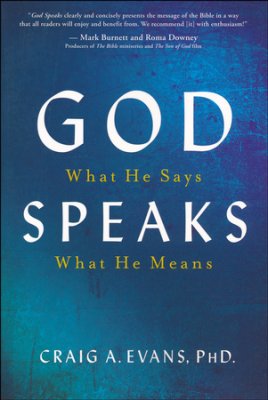
Craig Evans: God Speaks

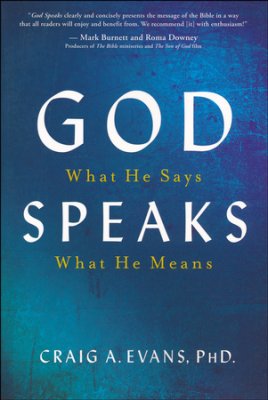 Craig A. Evans, God Speaks: What He Says, What He Means (Franklin, TN: Worthy Publishing, 2015), xii + 255.
Craig Evans is a well-known evangelical scholar and writer. Since 2016 he has been Distinguished Professor of Christian Origins at Houston Baptist University and before that taught at Acadia Divinity College from 2002-2015. This volume is a topical introduction to the Bible for lay people and those with little knowledge of biblical revelation. It covers key issues about the Bible from an apologetic viewpoint that seeks to explain what the Bible is and why it is important to listen to its message. Evans answers common objections to the Bible and presents the biblical worldview in an appealing manner. As a type of study guide each chapter closes with two or three points under the heading “Why Does This Matter to Me?” The emphasis is on practicality and challenges readers to search for truth. There is a mild philosophical touch to the writing but without being offensive or overbearing.
The first two divisions of this 13 chapter volume explore “What Is the Bible?” (chapters 1-2) and “What Is the Bible About?” (chapters 3-9) and take up 170 pages. Evans explains the Bible’s two testaments, the original languages of the Bible, the Apocrypha, and literary genres. Unfortunately, he asks whether the great Flood and the Tower of Babel are “historical narratives or parables” (p. 28), and conveys in note #18 on p. 248 that “truth is often conveyed in parables” when referencing Genesis 1-11 and refers readers to Peter Enns’ The Evolution of Adam (Brazos, 2012). I appreciated, however, Evans’ explanation of Matthew 19:28 and Luke 22:28-30 that “Jesus evidently expected his own disciples, at a time known only to God, to form a new government, to sit on thrones judging (in the sense of administering, not in the sense of condemning) the twelve tribes. The reference to the ‘twelve tribes’ also implies that Jesus fully expected the restoration of Israel—all Israel” (p. 134). He also rebuffs the idea of “some interpreters, that Gentiles or Christians replace the Jewish people. Such an interpretation is anachronistic and inaccurate” (p. 134).

Evans’ third and final section answers “Common Questions about the Bible” and numbers 60 pages. There are four chapters in Part Three. The first and longest of these chapters deals with how to interpret the Bible. Evans recommends the popular books by Fee and Stuart (How to Read the Bible for All Its Worth and How to Read the Bible Book by Book), as well as N. T. Wright’s the Bible for Everyone series published by Westminster John Knox. Chapter 11 ably deals with the question of violence and anger in the Bible including God’s commands for Israel to conquer the Land of Canaan and kill off its wicked inhabitants. Chapter 12 features brief explanations of 22 archaeological finds that support the Bible’s truthfulness or credibility in one way or another. They include the Rosetta Stone from Egypt and the “Pilate Stone” from Caesarea, the Caiaphas, James, and Yehohanan ossuaries, the “Jesus Boat” from the Sea of Galilee, the Gallio inscription from Delphi, and the Dead Sea Scrolls of Qumran just to name a few.
Evans describes his own book as “a solid, easy-to-understand guide to the Bible” (p. 11). However, he waffles on the age of the earth and the creation of man, saying “However old the earth is, at some point and in some way God created human beings” (p. 13). Regarding biblical criticism, Evans apparently discounts the Bible’s many claims that Moses wrote the Pentateuch, asserting that the oldest “Old Testament books date to about 1000 BC” although “some portions of the oldest books could be earlier” (p. 14, emphasis mine). Moses lived from about 1500-1400 BC. Evans also does not believe the 6th century BC Daniel wrote the book attributed to “Daniel,” but instead sides with liberal scholars holding that Daniel “is usually dated around 165 BC (although the stories in Daniel are probably much older” (p. 14). That kind of compromise is outdated and should have no place in a conservative evangelical book of this kind with a Foreword written by Mark Burnett and Roma Downey. I noticed only a few typographical mistakes. The Table of Contents has “Part 1” followed by “Part Two” and “Part Three.” The numbers should each be spelled out to maintain proper parallelism. Page 3 has “Other then” which should be “Other than.” The mention that all biblical quotes, unless otherwise indicated, are from the ESV is violated numbers of times, as on pp. 51-52 in citing Psalm 19:1-2. Nevertheless, Evans writes very well and simply and his book should prove helpful to many readers. Its contents are filled with helpful factual material and its aim is to reach those who need to understand the Bible better but lack the necessary tools to do so.
Reviewed by James A. Borland
Preview God Speaks: https://books.google.com/books/about/God_Speaks.html?id=qkw1CgAAQBAJ