Craig Keener: Acts, Volume Three

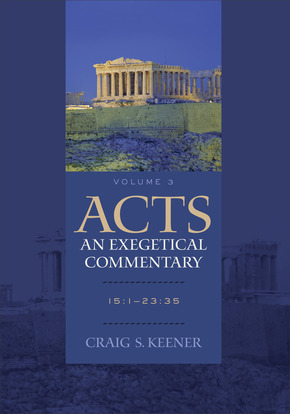
 Craig S. Keener, Acts: An Exegetical Commentary, Volume 3, 15:1-23:35 (Grand Rapids: Baker Academic, 2014), xxxix + 2193-3348, ISBN 9780801048388.
Those familiar with Craig Keener’s works will understand when I characterize his third volume on Acts as an encyclopedia of background, history, and solid exegesis all from a conservative evangelical stance. This mammoth tome runs from p. 2193-3348, with an additional 26 two column pages of the abbreviations used! This volume by the Asbury Theological Seminary professor covers Acts 15-23.
Keener argues that the Jerusalem Council met in 48 C.E. and should be paired with Gal 2:1-10. He thoroughly covers the Council’s meeting and its conclusions on the issues in just over 100 pages. Keener comments extensively on Jewish-Gentile marriage as seen in Timothy’s parents in Acts 16:1.
The Holy Spirit’s guidance in Acts 16:6 was primarily negative awaiting the vision of the Macedonian man in 16:9. Keener asserts that the Spirit forbade Paul’s movement into Asia to allow Paul to gain experience in Macedonia and Achaia against political and philosophic foes that would strengthen him for battle later on in Ephesus. He notes that the phrase “the Holy Spirit,” used only twice in the OT is now the standard nomenclature for God’s Spirit in 16:6 and that the next verse identifies the Holy Spirit as “the Spirit of Jesus” in the UBS Greek text. This title for the Holy Spirit is unique to the NT.
Luke’s use of the first person plural “we” in his factual narratives identifies Luke as an eye witness in a group setting while keeping the focus on Paul and Silas and their larger mission. Keener discusses this “first person” issue and numerous other historical examples of it from other ancient writers. Keener points out the propriety of Paul’s company accepting the hospitality of Lydia and has excursuses on hospitality and inns in the ancient world.
Keener gives many pages to explaining “Pythoness Spirit” and “Demons and Spirit Possession” (pp. 2422-2456). Paul’s expulsion of the slave girl’s false spirit (16:18) is the first miracle Luke records on Paul’s second journey. Acting in Jesus’ name ties Paul to Jesus’ ministry in Luke’s Gospel (Lk 10:17).
Various ancient views on suicide accompany Keener’s treatment of the Philippian jailor who almost took his own life. The salvation of the jailor and his family was purely by faith in Christ.
Keener carefully notes how Luke chronicles Paul’s movements, for example, escaping from Thessalonica at night. Keener sees this as courageous and at the behest of the new Christian leaders of that city. Though Paul was willing to die for Christ, to stay in Thessalonica may have caused his death for a charge of treason, and may have jeopardized the new church’s continuance. Instead, both prospered.
The Epicureans and the Stoics are covered with extensive excursuses as background for Paul’s visit to Athens. Paul’s speech on Mar’s Hill also receives attention for its rhetoric and use by Luke in reporting speeches.
Paul’s ministry in Corinth is supported by interesting historical material about Roman Corinth and Claudius’ expulsion of Jews from Rome, of whom two were Aquila and Priscilla. What drew Paul to this couple—shared faith, a common trade, or Paul’s mission? Keener says, probably the latter. Keener produces some excellent historical notes to pinpoint Gallio’s term of office as proconsul of Achaia in Corinth, including the year that Claudius expelled Jews from Rome. Gallio served in Corinth from July 1, 51 C.E. to July 1, 52.
The mention of Priscilla before Aquila in Acts 18:26 in the UBS text probably indicates that Priscilla was the primary instructor in their private meeting with Apollos.
Keener explains that the Ephesian disciples’ “defective experience and knowledge of the Spirit has alerted Paul to their incomplete knowledge of Christ” (p. 2819). He continues, “John’s baptism was good, but it was only preparatory to baptism in Jesus’s name and the greater baptism in the Spirit (Acts 1:4-5; 2:38)” (p. 2820).
In summary, Keener’s work is well worth reading. It is loaded with gems to make preaching and teaching come alive. Keener is well organized, readable, interesting, and valuable. I found the work to be thoroughly informative and enjoyable. The book is attractively laid out on 7 x 10 inch pages, with ample white space.
Reviewed by James A. Borland
Publisher’s page: http://www.bakerpublishinggroup.com/books/acts-an-exegetical-commentary-volume-3/335572