David J. Hesselgrave: Paradigms in Conflict

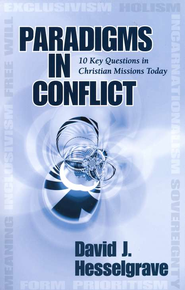
 David J. Hesselgrave, Paradigms in Conflict: 10 Key Questions in Christian Missions Today (Grand Rapids: Kregel, 2005), 368 pages, ISBN 9780825427701.
It is rare to find a very readable and theologically sound volume that examines current missiological issues perceptively with historical backgrounds, biblical exegesis, and practical insight by a recognized giant in the field. David Hesselgrave covers ten key topics such as sovereignty and free will, whether one can be saved without hearing the gospel and trusting Christ, whether common ground is possible to find with other religions, holism and prioritism, the missionary models of Christ and Paul, spiritual warfare, the essence of a missionary “call,” contextualization, prophetic alerts, and the real purpose of missions. The volume has forewords by both Ralph Winter and Andreas Köstenberger.
Each chapter runs about 35 pages and is interesting, readable, informative, thought provoking, and practical. The issues are as the title suggests–key. Each deals with seminal truths. Hesselgrave believes and applies the inerrancy of the Scriptures. Twelve illustrations dot the book, including a chart demonstrating four ministries of the Holy Spirit in missions (p. 193). Each chapter includes a bibliography averaging about thirty important recent sources, including periodical articles. Hesselgrave is fully abreast of the thinking on each topic and explains why each is so vital to understanding and accomplishing the true task of the Great Commission. In citing the history of the modern missions movement, Hesselgrave is not afraid to critique friend and foe alike, but with a kind and gentle spirit. He chides the downward drift in the World Council of Churches’ missions programs and warns of similar slides in current movements. He discusses Kraft’s contextualization and the TNIV, concluding that both do damage to “the verbal-plenary understanding of revelation and inspiration.” Hesselgrave agrees with Alva McClain and Robert Culver on the meaning and purpose of church, kingdom, Scripture, and mission, and contrasts that with the mistaken views of George Ladd, James Engel and William Dyrness. The volume also contains a helpful nine page subject index and a three page Scripture index.
On the issue of common ground, Hesselgrave notes that most, if not all, of the similarities between Christianity and other religions are too flimsy and not true parallels. For example, “The Allah of the Qur’an is very unlike the Triune God of the Bible” (p. 99). The only real common ground is that all people in every culture are sinners. One of the bluntest statements Hesselgrave makes, after a search for common ground in other religions is, “Perry is right when he avers that the various religions represent ways in which humankind is being led away from God, not toward him” (p. 102). He adds, “Dissimilarities may in fact prove to be more useful than similarities in communicating Christ and the gospel. This often is the way that new knowledge and understanding are attained. After all, the Christian faith (in its revelation if not always in its practice) is absolutely unique. There is no other faith like it” (p. 105).
Regarding the common ground of sin, Hesselgrave points out that all of us are sinners before a holy God. “That is the common ground on which both Christian missionaries and their non-Christian hearers stand. We must not only admit it; we must insist upon it. If there is any one key that unlocks the door to common ground it is ‘missionary self-exposure.’ … So sin and sinnerhood can and must be explained. But how much easier to understand if they are permitted actually to see a sinner” (pp. 111-112).
Hesselgrave points to William Carey as the “father of modern missions” and emphasizes two important words in the title of Carey’s book, An Inquiry into the Obligation of Christians to Use Means for the Conversion of the Heathen. Those words are means and conversion. The means God uses are people – missionary societies; and their task was and still is to “convert the heathen.”
All religions other than Christianity, Hesselgrave argues, are “systems that Satan, disguised as an ‘angel of light,’ employs to predispose adherents to disbelieve in the Christ of the biblical gospel” (p. 90).
Only a few mistakes were encountered. In commenting on the Greek word kosmos (world), Hesselgrave says, “In that chapter alone [John 16] it appears some forty times” (p. 190). I could only find seven uses of kosmos there. Wilbur Pickering is misspelled as Wilber on p. 265; for Adolph Saphir he has Sapir (p. 336), and Dan Reid is renamed Donald on p. 340. These errors make it into the index as well. Ironically, William Dyrness is morphed into William Dryness, but only once (p. 333). An extraneous “rest” occurs on the second to last line of p. 335, and there is a noticeably inconsistent use of the apostrophe to show possession with words ending in “s” (pp. 338-340–Jesus’, versus Edwards’s, p. 349, and most elsewhere). Hesselgrave rather generously states that Paul “provided approximately half of the entire New Testament record” (p. 155). It might be more accurate to say approximately one third, whether considered chapter wise (87 of 260), by total verses, or even pages written. I also thought Hesselgrave was a little too hard on Barnabas after his disagreement with Paul–amassing five not so logical arguments against Barnabas and in favor of Paul (p. 219).
Despite those minor issues, Hesselgrave is delightful to read. I was informed and challenged in my thinking on every page and consider this to be the most enlightening book I have read in some time. I would recommend that anyone interested in missions at any level give it a thorough reading.
Reviewed by James A. Borland