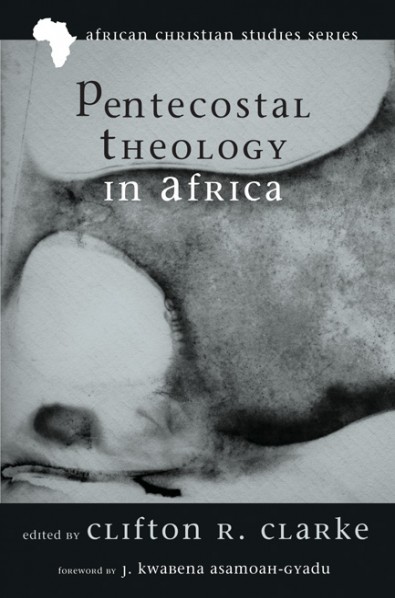
Clifford R. Clarke, ed., Pentecostal Theology in Africa, African Christian Studies Series (Eugene, Oregon: Pickwick Publications, 2014).
This compendium of articles put together by Clifton Clarke excels in being a clear, carefully presented and carefully argued account, taking a variety of different theologically-rooted angles on AP (African Pentecostalism). As would be expected, the tone is optimistic and positive to the effect that AP has important significant contributions to make to the wider field of theology, both within Africa, and in the world at large. Being a compendium that includes a variety of work by different authors makes it hard to draw too many conclusions about the whole. I will endeavour to give an enticing flavour of the book below.
The claim aptly made and articulated by Gallegos, that APs being rooted in ‘primal’ ways of thinking gives them advantages in Biblical interpretation over perhaps highly educated but ‘modern’ people, rings true. Pentecostalism in Africa is in some respects a ‘coming of age’. This is a very valuable comment: theological theorists’ search for indigeneity in African Christianity can find many of their answers in AP. AP churches are, in many instances, self-governing, and ready to be outspoken beyond what they have been told by their Western instructors must be right. AP is a part of a great revolution for Africa!
African Pentecostalism is a part of a great revolution for Africa!
Ngong points us to a key need for AP to leave space for the modern world. What good, after all, is a theology that cannot recognise or advocate for science and technology that profoundly dominate modern times? Landfair considers APs orientation to eschatology. Some scholars consider AP to be very this-worldly, despite its emphasis on God’s Spirit. Landfair unpacks apparent contradictions to such presuppositions. Gifford’s contribution is primarily cynical. That is a welcome compliment, giving us a non-believers’ perspective, challenging scholars on AP to consider how practices rooted in the countering of witchcraft can at the same time lead to socio-economic progress. A chapter by Ogungbile on the prosperity gospel points to ways in which what may seem ‘clearly wrong’ from the West, is not necessarily so for APs, for whom poverty after all is a kind of sickness, and who read frequent accounts of Jesus’ healing in the Gospels. This discussion highlights a set of evident contradictory relationships between AP and modernity.
How do Africans see the ‘prosperity gospel’ differently than Westerners?
Frahm-Arp gives us a refreshing and articulate account of AP view on gender. Her straightforward laying out of AP views related to gender could be of great help to people in the West wondering why the behaviour of women and men in AP contexts differs from Western norms. In the latter part of the book, Fleming and Ngong throw new insights onto social action and religious pluralism with respect to APs. A weakness in the approach of both of them, is that they seem to take a dominant Western view and to ‘Africanise’ it, rather than to explore AP practice on its own terms.
Editor Clifton R. Clarke is the Assistant Provost for the William E. Pannell Center for African American Church Studies and Associate Professor of Black Church Studies and World Christianity at Fuller Theological Seminary.
By way of conclusion, this selection of essays is a very readable cataloguing of key issues pertaining to APs. Different depths of exploration of the issues concerned means that this book contains some evaluation and scholarly analysis of matters raised. It successfully gives a reader a flavour of much that is going on in Africa today. Weaknesses of the book include its failure to engage sufficiently with AP’s rooting in indigenous contexts: much evaluation of AP is as if it is a variant on Western Christianity. At times too positive for a scholarly text, and too much rooted in a perspective from the West, the above weaknesses arise from an underestimation of the impact of African languages (barely mentioned as an issue: most of the book seems to assume AP is entirely rooted in Western English) and cultures on the subjects under question. The book is a suitable stimulation to discussion on AP at undergraduate level. It provides a broad background to issues in AP. It makes a good introduction to a breadth of issues that can enable a reader interested in knowing more to later explore AP in more contextual detail.
Kevin J. Vanhoozer, Charles A. Anderson, Michael J. Sleasman, eds., Everyday Theology: How to Read Cultural Texts and Interpret Trends (Grand Rapids: Baker Academic, 2007), 285 pages, ISBN 9780801031670. Everyday Theology deals with the daily encounters that influence people’s thoughts, those multitudes of encounters that no theologian can afford to ignore. The book considers popular…
In this guest article by David Redden, he discusses what an integrated paradigm of worship and discipleship might look like for today’s Pentecostal/charismatic. There is much talk about today as to what is Postmodern. You can read books and articles from Leonard Sweet to Peter Wagner and get as many variations on that theme as…
There is power in the cross of Christ. In this excerpt, pastor, theologian, and historian Cletus Hull introduces us to his new book, The Wisdom of the Cross and the Power of the Spirit in the Corinthian Church: Grounding Pneumatic Experiences and Renewal Studies in the Cross of Christ. The cross of Jesus and…
Gastón Espinosa, Latino Pentecostals in America: Faith and Politics in Action (Cambridge, MA, and London: Harvard University Press, 2014), xi + 505 pages. Daniel Ramírez, Migrating Faith: Pentecostalism in the United States and Mexico in the Twentieth Century (Chapel Hill, NC: The University of North Carolina Press, 2015), xix + 283 pages. Why should readers…
Sammy Alfaro, Divino Compañero: Towards a Hispanic Pentecostal Christology, Princeton Theological Monograph Series 147 (Eugene, OR: Pickwick Publications, 2010), 164 pages, ISBN 9781606086995. ‘Divine Companion’ is an insightful and innovative exploration of ways of approaching both Christology and an understanding of the Spirit at work in our lives. The published version of a PhD thesis,…
This summer, I was selected to attend the annual Black Theology and Leadership Institute (BTLI) at Princeton Theological Seminary. Dr. Yolanda Pierce – the Elmer G. Homrighausen Associate Professor of African American Studies and Literature and Liaison with the Princeton University Center for African American Studies – has managed to create a think-tank of…


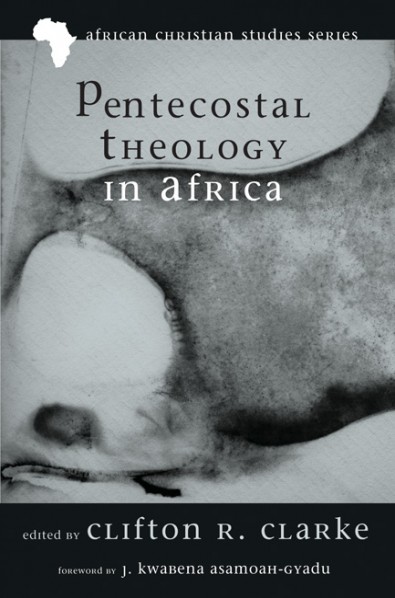 Clifford R. Clarke, ed., Pentecostal Theology in Africa, African Christian Studies Series (Eugene, Oregon: Pickwick Publications, 2014).